Life
The Flag We Never Really Look At
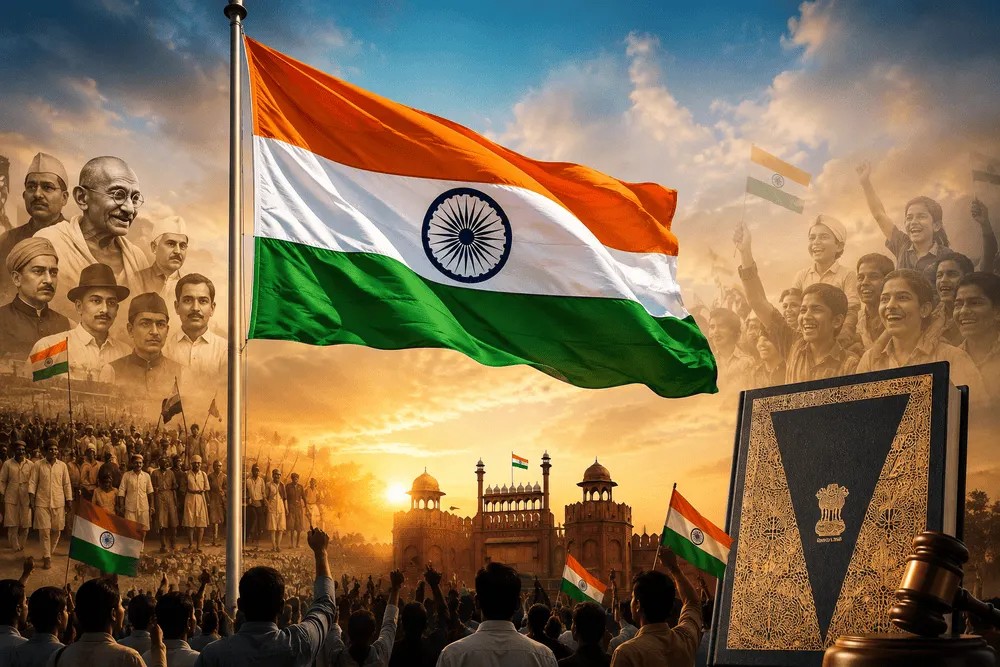
Every Independence Day, we hoist it, photograph it, and post it. Most of us have no idea how many times it almost looked completely different.
You’ve seen it thousands of times.
On government buildings, on cricket jerseys, on WhatsApp forwards every August 15th. You know the colors — saffron, white, green. You know the wheel in the middle. You could draw it from memory.
But do you know what it took to get here?
The Indian flag we recognize today didn’t arrive fully formed at independence. It went through nearly five decades of argument, iteration, and redesign — shaped by revolutionaries, spiritual leaders, political movements, and ultimately, a nation trying to define itself before it even existed.
Here’s the real story.
It Started With a Nun
The first version of what could be called India’s national flag was designed in 1904 — not by a politician, but by Sister Nivedita, an Irish-born disciple of Swami Vivekananda who had given her life to India’s cause.
Her flag was a bold red and yellow tricolor, carrying a vajra (thunderbolt) and the Bengali words for “Hail to the Motherland” at its center. It wasn’t widely adopted, but it planted a seed: India needed a flag. Not just a symbol of a movement, but of a nation.
The idea refused to die.
The Swadeshi Experiment
During the Swadeshi Movement of the early 1900s, as Indians began boycotting British goods and demanding self-rule, a new flag emerged — one that tried to solve a uniquely Indian problem.
How do you represent a country with Hindus, Muslims, Sikhs, Christians, Parsis, and dozens of other communities under a single symbol?
The answer, at the time, was to put everyone in. The flag used horizontal stripes of red, yellow, and green — and included symbols representing different religious communities. It was a well-intentioned attempt at unity.
It was also too crowded to work as a national symbol.
But the instinct behind it — unity in diversity — would survive and eventually become the defining principle of whatever flag India chose.
Gandhi’s Proposal
The flag that really changed everything came in 1921, when Mahatma Gandhi walked into the All India Congress Committee meeting with a proposal.
Three equal horizontal stripes:
- Saffron at the top
- White in the middle
- Green at the bottom
And at the center — a spinning wheel, the charkha.
The charkha wasn’t just a symbol. It was a statement. Gandhi saw it as the heartbeat of India’s independence strategy: if every Indian household spun their own cloth, they could break economic dependence on Britain. The flag, in his vision, wasn’t decorative. It was a call to action.
The Congress adopted it. For the next two decades, this was the flag of the independence movement — carried in protests, raised at meetings, torn down by British authorities, and raised again.
The Final Change: The Wheel of Dharma
When India finally gained independence in 1947, one last decision remained.
The charkha — Gandhi’s spinning wheel — was removed from the center. In its place came the Ashoka Chakra: a 24-spoke navy blue wheel drawn from the Lion Capital of Emperor Ashoka, the Mauryan ruler who had governed most of the Indian subcontinent in the 3rd century BC, and who had chosen dharma — righteousness — over conquest after witnessing the devastation of war.
This was a deliberate choice. The spinning wheel looked backward, toward economic self-reliance. The Ashoka Chakra looked forward — and outward — toward India’s place in the world. It carried a different message: not just self-sufficiency, but justice, progress, and the continuous motion of a civilizational ideal.
Gandhi was reportedly unhappy with the change. He had wanted the charkha on the flag of free India.
But the constituent assembly had made its decision. On July 22, 1947 — weeks before independence — the tricolor with the Ashoka Chakra was officially adopted as the national flag of India.
What the Colors Actually Mean
The three colors are not arbitrary. Each carries a specific meaning that was debated and chosen carefully:
Saffron — Courage, sacrifice, and the spirit of renunciation. The saffron of Indian ascetics and warriors, of people who gave up personal comfort for something larger.
White — Peace, truth, and the path of righteousness. Not just the absence of conflict, but the active pursuit of honesty in how the nation governs itself.
Green — Fertility, growth, and the land itself. India was, and remains, an agricultural civilization — a country whose prosperity has always been tied to the earth.
The Ashoka Chakra in navy blue sits at the intersection of all three. Its 24 spokes represent the 24 hours of the day — a reminder that the wheel of dharma never stops turning.
The Flag as a Living Document
What’s remarkable about the evolution of the Indian flag isn’t just the history. It’s what that history reveals about the people who shaped it.
Sister Nivedita, a foreigner who loved India more than many of its own citizens were allowed to. Gandhi, who wanted a symbol of economic revolt, not just political independence. The architects of the constitution, who chose the wisdom of Ashoka — an emperor who renounced violence — as the visual centerpiece of a newly free nation.
Every iteration of the flag was an argument about what India should be. Not just what it was, or what it had suffered, but what it was trying to become.
That argument didn’t end in 1947. It’s still happening.
Every time we talk about what it means to be Indian — in conversations about religion, language, history, democracy — we are continuing the same discussion that produced those three colors and that wheel.
The flag isn’t just a symbol of what was built.
It’s a question we’re still answering.
Happy Independence Day. 🇮🇳
I write about India, culture, and the stories we carry. Find me on X and YouTube.